
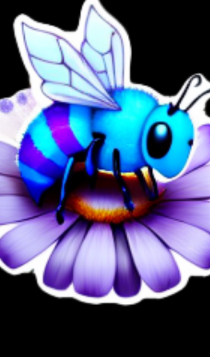
They seemed to appear from nowhere; and spread everywhere very fast for slow, fat bumblebees and nobody had an answer for them; not in time, that is. I remember the first blue bee that I saw; before the danger was known, certainly before all the events of that hectic period. I had been standing by the cage, admiring the plants inside and out; I have always had a passion for plants, and would see to their needs every day, events allowing.On that particular day, I had seen the bee drifting towards me, and had held out my hand to see if it would land, as bees often did. I noted that it was a dark bumblebee or carpenter bee, shining in the poor light of day. It was cloudy, and I was wondering whether or not to water the plants inside the cage – vain sentiment now it seems, with all the rain of these latter days. But in those long ago forgotten days: three months ago now: water was distinctly at a premium, and one did not water the plants as the spirit moved.This little fat bee settled on my hand, nuzzling my fingers and looking for nectar; pollen; sugar; anything sweet would do. I looked a bit closer at her, noting the iridescence of her hairy body, the shimmering colour of her wings; and I saw with interest the deep cobalt of her stripes, normally yellow or white. There was a hint of purple where the light struck; and her body had a distinct weight on my hand; she was a solid, handsome creature, and the impression of more than met the eye was distinctive. I carefully walked to the elderberry tree, showing its small but vain flowers. The elderberry tree had never borne fruit, the flowers decimated by the annoying rose beetles. She investigated my hand with patient care, walking up the Jupiter finger that I was holding close to the blossoms. She walked from finger to blooms, and I stepped back, feeling distinctly that I was witnessing something new and strange; something pivotal. I watched her about her business on the blossoms, collecting pollen on her pollen pads, already distended. She found some nectar and drank a fulsome draught before buzzing busily to the next bloom. I watched her at her labours for a short time before returning to the question of which plants to water that black and gloomy day. Certainly she hadn’t been the vicious, savage brute that the blue bumblebees were later made out to be; it struck me on review that they had been sorely provoked; they were gentle creatures until triggered. Mayhaps it was a scent; or sound; that made them use the weapon with which they had been equipped. They could – and did – sting with impunity when provoked; and one trigger I could suggest was loud noise. It was, after all, a battle scene where it was first recorded that they had displayed their devastating potential. The bullies of the Middle East were busy killing innocent civilians by the thousands when that dark, blue-purple cloud descended on their foul war machine, and proceeded to sting the soldiers; and some not so innocent civilians; to death. Certainly the blue bees had no respect for rank and privilege; if a person crossed their path, they were overwhelmed and stung to death. There were a number of new factors that came to light then, that I had not noticed during my initial encounter. Where a place was too hot, such as the deserts of the Middle East, the bees became nocturnal; and they appeared to have absorbed bioluminescence into their peculiar genes. For at night they had a beautiful pale blue glow; not that their victims saw it as beautiful. To the soldiers at night, those who were wakeful, that pale blue mist coming toward them was a fright and a dreadful thing. The mist would come, sweep over them in its blue buzzing pall; and those who slept would sleep on, cold and dread in the peaceful desert night. Some were stung; others were not touched; none could fathom why, to begin with, although it seemed obvious to me. A single sting from a single bee was an appallingly painful death sentence. In all my research on the topic, nobody who has been stung by the blue bumblebees has survived. This was new for bees; certainly the African Killer Bee had earned its reputation; but there it was ten or more stings that killed; ten little bees trading their lives that their colony survived. But the blue bumblebees were definitely new players. Their sting was clean; there were no bristles on the sting to cause it to lodge in the victim, killing the bee. The blue bumblebees could sting as often as they liked; and they did. Those genes had also dictated that the neurotoxin that the bees employed to cause pain; and hence chase the victim from their nest; be in the blue bumblebees very much more toxic – micrograms were all that was needed to cause a death through hideous pain. I estimated that their neurotoxin was in the order of a million times as toxic as cyanogen. And the swarms, in hundreds of millions, delivered vastly more than that lethal dose as they travelled their vengeful way. Vengeful? I wasn’t sure about that. As far as I could see of the situation, it was someone other’s revenge being accommodated by the bees; and I knew of no logic to include that speculative destination. The bees were acting, decisively and thoroughly, for a reason I could not fathom. I did not see them as a political tool; as there were none that capable or subtle at that time. From the information available to me I concluded that they were clearing the field; that other players know life and truth on this world. Certainly the levels of pollution at the time opened the doors to deep change and explosive evolution. The plants; the climate, the very high levels of carbon dioxide in the air; it was a mix very similar; yet also disturbingly different to the Carboniferous Era that had come before and laid down the coal, oil and gas beds even now being abused. The blue bumblebees were suggestive of an evolutionary jump; one of the first triggers that might lead to explosive plant growth, giantism, and the return, or redesign, of the huge creatures that had savoured those massive plants of that time. Certainly the decisive increase of radiation also suggested massive changes; and the blue bees, so similar and so different from the bumblebees of an older age, represented no small evolutionary change. Not many people were afforded the opportunity of examining the blue bees close up; I was probably one of the few who had handled a bee and survived. One of the more disturbing details about the little blue bumblebees; or ‘Faria bees’ as I had named them, was their bad habit of laying eggs in their victims; and sometimes quite a number of eggs. After all, the Faria bees weren’t pure vegetarians; they had the prevailing Hymenoptera habit of parasitism, and a nice warm body could, after all, support any number of baby bee larvae. It wasn’t immediately obvious; the eggs were most often laid in bodies to which no attention could be paid, as there were usually no-one to pay attention; and the eggs didn’t hatch at once. It took about two weeks for the larvae to mature and break out; I certainly didn’t sit around watching it happen; but once the larvae had done their time they burrowed out; often all at once, creating a new swarm in areas that had already been cleared by the bees. There are ways, I suppose, of clearing vast swarms of lethal, luminous blue bees; swarms that numbered in the hundreds of thousand millions; but few of the methods actually tried seemed to work. Certainly the numbers of bees swarming over the face of the world didn’t diminish much for all their efforts. There were reports of crop sprayers; and some much larger planes; brought down in flames by the bees. One way, apparently, of guaranteeing an attack by the luminous blue bumblebees was to spray them with pyrethroid or related compounds; these clearly didn’t have any impact on the health of the little blue bees. I have been accused of “beeing on the bees’ side”, a charge I resolutely deny; as the bees clearly weren’t on anyone’s side. They were, to all appearances, part of a natural process, one that was all about clearing up a huge and evolutionarily unsound mess, and they went about their various duties without fear or prejudice. Certainly they did more for human survival than the overcrowded and oil-hungry governments then in power had ever done, even though they were massacring the human populations. It was what humanity really needed; a removal of the dead weight and genetically flawed groups, a return to basic survival values, and a purging of detrimental technology and practices then on the point of stifling man’s ability to think. People, those who were able to, learnt to think, clearly and quickly; it was that, or being stung to death, after all. There were people; often quite large groups of people, who were not attacked by the bees, but no satisfactory reason for this oversight and selection on the bees’ part has ever been put forward. People had been moaning and going on about global warming and changed weather patterns; brought about, so they claimed, by pollution and emissions. I suppose that they were right; by and large, and as far as they went; although there were several details that they didn’t see fit to mention. On of these, of course, was the presence of large islands of plastic waste in the oceans; and very high levels of oil and other hydrocarbonic pollution on the water surface, all of which reduced the amount of water drawn up by evaporation, and a lowering of tropical water temperature. It didn’t seem much; but it was certainly enough. And wind farms. Nobody mentioned the impact of wind farms, though it seemed obvious to me. The huge fields of wind generators, the ‘best’ option as far as clean electricity was concerned, certainly played a catastrophic role in diverting wind patterns and changing wind flow wherever they occurred. Nobody seemed to notice; or care about; the displacement of wind currents and the development of superstorms that immediately followed the general installation of huge wind farms. Wind has no mind. It follows the rules laid down for it. And one of those rules was that the wind shall blow along the path of least resistance. Wind farms presented the breeze with a formidable new point of resistance; and while the winds, reluctantly, turned their turbines, by and large the force of the wind went elsewhere. I don’t suppose that any wind farm ever saw production of electricity peak above a third of expectations; and the displaced winds wrought havoc in new and totally unexpected places. The bees didn’t seem to mind changed wind patterns or superstorms; they made sure that they were snug for the duration, and set off again on their crusade the moment that the inclement weather had passed. They hid under eaves, in cracks of trees, under bridges and any shelter of that sort; sometimes invading houses through roof gaps and under door jambs; much to the dismay of the home owners. There didn’t seem to be an order; or a victim profile, when it came to the swarms. They went wherever and stung whoever; the deeper the defences, the more determined the bees became; and it was surprising the size of hole they could squeeze their little fat bodies through. Bee clothes, scented with smoke and accompanied with veils, was a sure way to provoke the bees, and any tiny gap in those defences was enough to let them through. They also followed fires, infuriated by the smoke; and smoggy towns and cities where emissions and fumes were the order of the day, were fair targets. A swarm of bees against a city seemed like a playable bet, until the swarms were enumerated. Often a swarm had ten million individuals, and one or two swarms of over a thousand million had broken cover in more populated places. They had crossed large bodies of water and were very much at home in forests; where they decisively discouraged logging in any form. They seemed to be guardians of nature and a huge vote against overpopulation, though their own numbers during the short time that they were active must have numbered nearly a thousand billion, ten times ten to the power of fifteen. They came; they stung; they went. The blue bumblebees; the Faria bees, are no longer as numerous as they were. They had a huge population spurt that had lasted maybe two months, then they faded into obscurity, although they didn’t vanish altogether. They can still be seen at night, when the wind has dropped, tiny blue fireflies making their way from flower to blossom, busy buzzing in the darkness. They like the cold; and their weird bioluminescence seems to rub off on the flowers, causing changes in the plants that they are pollinating. Some plants became small and delicate, others became huge and robust; and a few began to glow of themselves. All that the bees touched changed; including the people. The gas mix of the world at the time had something to do with this; as well as the pollution from other sources; plastic, paper, oil, chemicals, light and other radiation. There was an overwhelming load of radiant pollution, television, radio, cellular phones, wi-fi; it all added to the general pollution; and each element seemed to have been carefully calculated to do intense damage and make irrevocable changes to the environment; not much of it to the benefit of the ‘ dominant’ species of the time. Seldom has the axiom of rats in cages outbreeding their food supply and thereby destroying themselves, been so graphically demonstrated on such a large scale. Each gas played a role, each layer of filth and plastic, the farming of ecoli bacteria and its ploughing into the food supply as organic fertilisers. It was sad, but so slightly amusing, to see how the love of money twisted each eco-warrior’s goals to fill greedy wallets. Organic farming, at a much higher cost per item, led to a robust new form of ecoli bacterium lodging into common food items, causing general health issues on a scale never seen before. Plastic in the water and in the soil led to imbalances in water evaporation, electrolyte balances, higher capacitance in soil and water, causing common complex molecules to change into dangerous toxins and carcinogens. And the medical profession, while barely and partially solving problems, really throve on the pain and suffering of those foolish enough to trust their doctors. Capacitance of plastic in soil and water also led to much worse weather, particularly electrical storms. It was a complete and novel chemical and electrical broth, soil and sea alike, and added to this was the chemical pollution in the air, and the diversion of critical air masses by the wind farms. To this was added the melting of the glaciers, filling the ocean with light, cold layers of fresh water, causing the hot streams heading to the polar regions to sink below the fresh water, further reducing the water vapour leaving the oceans’ surfaces, and reducing the exchange of heat between equator and polar regions. This, with the chemical composition of the atmosphere, made such storms as occurred much worse, and the toxic nature of the falling rain began to make its presence felt; acid and toxic, both sulphonic acid and carbonic acid were but two of many toxic components, along with nitrous and halogenic acids; too much for some ecosystems to cope with, as well as spring-loading the changes in the ecology to come. If a creature could not cope with the acid rains, it died. If it could cope, it throve and became larger or more toxic; or both. It has been suggested that the addition of nitrogen compounds to the blue bumblebees’ venom contributed to the neurotoxin becoming lethal in relatively small doses. All the changes and most of the danger that followed were as a direct result of the industrial activity and pollution; and even the extensive mining added something to the disasters that followed. It all dovetailed together; each disaster leading cleanly and logically to the next, yet it seemed that nobody saw it coming. Certainly the blue bees, part of the Matrix as they were, came as a very nasty surprise to all who encountered them; especially the bee keepers who had been milking their bees for their venom. The new blue bumblebees would not tolerate anything of the sort. Smoke that panicked the more docile honey bees, simply enraged and infuriated the blue bees; and a person didn’t do that twice. The blue bumblebees also seemed much more intelligent than honey bees; or the people of the time. The blue bees deliberately sought encounters and used their opportunities to the best advantage. Also, they didn’t seek hives as the honey bees did; they were social bumblebees with a parasitic streak, since their eggs could be injected into living; or soon to be dead; prey. They didn’t rely on collecting nectar and pollen to make all the food for the nest, although they did this, and pollinated a much wider range of plants with far more industry than the other players. It was as if they were deliberate agents of change, and took their labours very seriously. Some of the bees had been tracked flying for days before returning, plimsoll down, to their nests. The blue bumblebees broke the balance of power between nations; some nations ceased to exist, and their land, desert or forest alike, stank for months with the putrescence from myriad bodies rotting where they lay. Often enough the social network broke down entirely; no services of any sort existed after the blue bees had passed by. Small islands in particular lost the human touch as the bees swept through. The islands were green, lush, back as nature intended; and a person reviewing each deserted island would often as not share a grin with a skull in the bushes or unexpectedly meet a skeleton sunbathing on an otherwise pristine beach. New species and interesting crosses in plants started to appear as the Faria bees took a claw in pollination. It was as if the strange genes of the blue bees impacted upon the plants they were pollinating, as well as the lethal chemical mix in the atmosphere and the water in the soil beneath. Each element played its part; and each change, not seen or noted at the time, became a part of the strangest new world beyond the technological age. The boldest imaginings of the tech era could not hope to encompass the world that lay beyond; although a mere six months; six months of incredible pain and torment lay between the two.